Mugen
WHAT IS M.U.G.E.N? And Hentai!!!
You might be wondering: "Okay, I’ve seen this absolute casual's website offering nude [Hentai] chars, add-ons, and stages, but where do I actually install them?" Everywhere you look it says "M.U.G.E.N," and there's even info about who made it, but how do you use it? Where do you find it? Or is it just straight-up pornware?
To kick things off, M.U.G.E.N is a free 2D fighting game engine designed by Elecbyte (Wikipedia, 2025). With it, you can build practically anything you’ve ever wanted to see in a fighting game. Almost everything in M.U.G.E.N can be modded or built from scratch—your imagination is the only real limit. It’s not a standalone game out of the box; you have to configure it yourself by adding characters, stages, background music, and everything else. The vanilla download comes as a zip file containing the core engine, one sample character [Kung Fu Man], and two stages.
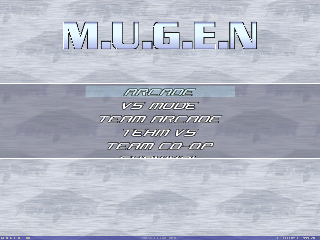
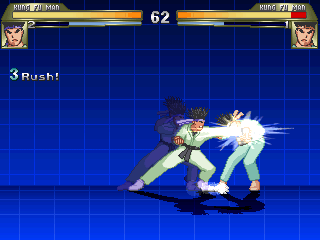
For over a decade, a massive urban legend claimed that Elecbyte was formed by rogue, ex-Capcom or SNK developers bound by strict non-disclosure agreements (XGargoyle, 2022). However, a breakthrough investigation debunked this myth. Public records and legal documents revealed that Elecbyte actually originated as a college project by three students from the Electrical Engineering and Computer Science department at the University of Michigan in Ann Arbor (University of Michigan, 2023; Wikipedia, 2025). Before launching M.U.G.E.N publicly on July 27, 1999, the team operated under a testing group known as T.E.S.T.P. on a website called U.N.I.T.E.D., where they secretly released the first asset packs featuring ripped characters like Guile and Blue Mary to protect themselves from copyright lawsuits (XGargoyle, 2022).
The engine's history spans three distinct eras. It began as an MS-DOS application (1999–2001) before transitioning to Linux (Wikipedia, 2025). Following their graduation, the developers abruptly vanished in 2003, leading the community to keep the platform alive by leaking and hacking a private beta to create "WinMUGEN," which added high-resolution capabilities (Manestreet, 2021). Elecbyte made a surprise return between 2009 and 2011 to release stable HD versions before disappearing permanently (Manestreet, 2021).
Now, here is the real magic that makes enthusiasts from all over the world so passionate: you can completely overhaul the default UI, craft your own custom assets, sound effects, characters, and an endless amount of tweaks.
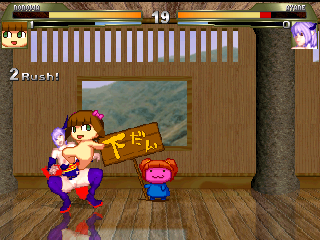
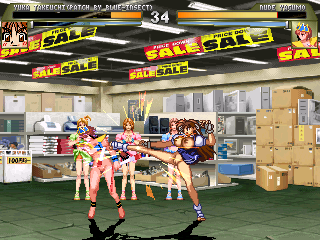
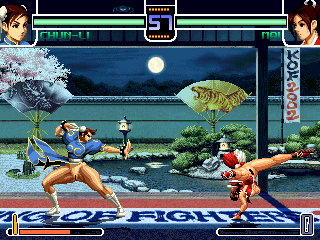
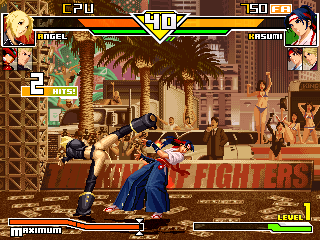
As you can see, there’s huge potential for changing up both the visuals and the core combat mechanics. But it doesn’t stop there. If you’ve got a creative mind and a few adult-oriented ideas, you can edit or create your dream characters exactly how you want. In this scene, those specific custom modifications are better known as Hentai versions.
Because Elecbyte never released M.U.G.E.N's original source code, its modern evolution has shifted entirely to the community through I.K.E.M.E.N. GO, an open-source spiritual successor written in Go that supports classic M.U.G.E.N files while adding modern features like rollback netcode and 3D stages (XGargoyle, 2022). Creators have developed all kinds of unique characters using this engine, but there is always room for new ideas because your imagination never runs out.
Evolution & Official Version History
The technical journey of the engine can be traced through five major iterations:
DOS M.U.G.E.N (1999–2001): The initial public software. Development ceased after the November 2001 build.
Linux M.U.G.E.N (2001–2003): A port released alongside the DOS version, featuring a 64 MB memory pre-caching mechanism.
WinMUGEN (2003–2008): A crucial community milestone. After Elecbyte paused development, community members worked with a private Windows beta to allow high-resolution gameplay on modern operating systems.
M.U.G.E.N 1.0 (2011): Released on January 10, 2011, this stable build standardized high-definition (HD) resolution support and fixed major memory leaks.
M.U.G.E.N 1.1 Beta 1 (2013): The final official framework released on August 7, 2013. It introduced hardware-accelerated zoom functions via the GPU and 32-bit true color depth.
References
Manestreet. (2021, July 20). The mystery of Mugen. Mane Street Blog. https://manestreetblog.com/2021/07/20/the-mystery-of-mugen/ University of Michigan.
University of Michigan. (2023, September 22). U-M origins of legendary gaming mystery revealed. University of Michigan EECS News. https://cse.engin.umich.edu/stories/u-m-origins-of-legendary-gaming-mystery-revealed Wikipedia.
Wikipedia, The Free Encyclopedia. (2025, October 17). Mugen (game engine). https://en.wikipedia.org/wiki/Mugen_(game_engine)
XGargoyle. (2022, May 20). Fighting game mysteries - Elecbyte. SuperCombo. https://supercombo.gg/2022/05/20/fighting-game-mysteries-elecbyte